

Structural Steel Bracing Fabrication Franso
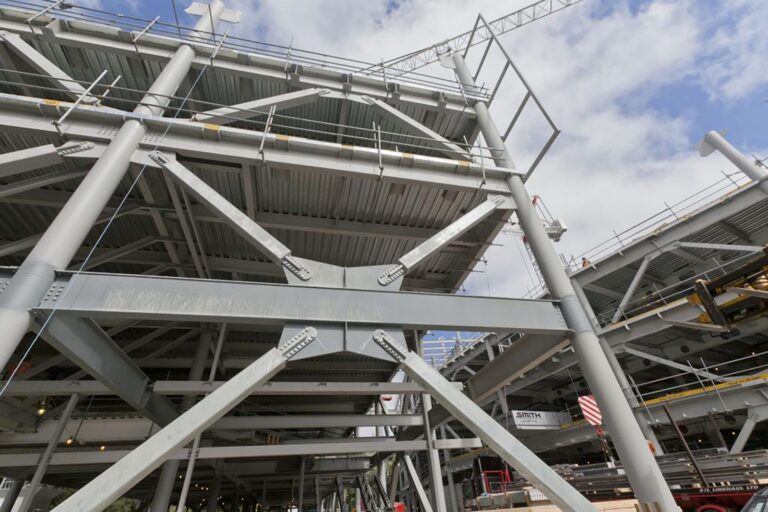
For modern steel structures, the choice of lateral stability system is critical. Whether designing a high-rise in a seismic zone or a specialized industrial facility, engineers must balance strength, ductility, and cost. At GPS Fabrication, we understand that the foundation of a resilient structure lies in its bracing system. This guide explores the key differences between concentric brace frames and eccentric brace frames, their role in seismic resistance, and the engineering standards that govern their design.
Concentric Braced Frames (CBFs)
A concentric braced frame is a structural system where the centerlines of all bracing members intersect at a single point at the connections. This geometric alignment creates a truss-like system that is highly effective at resisting lateral forces.
How They Work
In a CBF, the braces are designed to carry axial loads. When lateral forces from wind or seismic activity hit the structure, the braces transfer these loads directly to the foundation. The intersection of the braces and beams at a common node means the brace members experience primarily tension and compression. However, under compressive loads, steel braces are susceptible to buckling. This vulnerability has led to innovations like Buckling Restrained Braced Frames (BRBFs), which enhance the performance of CBFs. Research indicates that among various configurations, the X-bracing system often demonstrates superior performance in limiting story displacement and managing overall seismic response.
Applications and Considerations
CBFs are a common choice for mid-rise buildings and industrial structures due to their stiffness and straightforward design. However, because the braces can buckle under compression, they may have limited ductility under extreme seismic events. AISC standards provide detailed guidelines to address these limitations and ensure safe, reliable designs.
Eccentric Braced Frames (EBFs)
Eccentric brace frames are designed with a deliberate offset. Unlike concentric frames, the centerlines of the braces do not intersect at the connection. Instead, they are offset, creating a distinct “link” beam between the brace members.
Ductility and Energy Dissipation
This link is the heart of an EBF. It functions as a ductile fuse that absorbs energy by yielding inelastically when the structure is stressed by an earthquake. The design ensures that this link yields before the braces or columns buckle, protecting the integrity of the main structure. EBFs are particularly effective in high-seismic regions where energy dissipation is prioritized over pure stiffness. Research has shown that EBFs, while more complex in connection detail, offer significant advantages in energy dissipation compared to traditional concentric systems.
Gusset Plate Connections and AISC Standards
The performance of any bracing system heavily depends on its connections. Gusset plate connections are the critical steel plates that link the braces to the beams and columns. They are subjected to significant axial, shear, and moment loads and must be designed to withstand these stresses. The behavior of gusset plates, especially in compression, is influenced by factors like plate thickness, steel grade, and connection geometry. Innovative design approaches even utilize gusset plates as ductile fuses to improve frame behavior. All these elements must be engineered in accordance with the AISC standards and the AISC Steel Construction Manual, which govern the design, fabrication, and erection of structural steel buildings.
Why Steel Fabrication Expertise Matters
The success of these advanced structural systems relies on precision fabrication. At GPS Fabrication, we combine technical expertise with advanced manufacturing capabilities to produce custom steel components, including the complex connections required for CBFs and EBFs. Our team is adept at navigating the challenges of modern structural design, ensuring compliance with AISC standards for safety and performance.
Frequently Asked Questions
What is the main difference between a concentric and an eccentric braced frame?
In a concentric frame, brace centerlines intersect at the connections, making the structure very stiff. An eccentric frame features a deliberate offset, creating a “link” that yields under stress to dissipate earthquake energy.
Why are eccentric braced frames better for earthquakes?
EBFs are designed to be ductile. The “link” beam absorbs energy by yielding in a controlled manner during an earthquake, preventing sudden collapse and protecting the primary structure from damage.
What standards do you follow for designing these bracing systems?
All our designs and fabrication processes strictly adhere to the latest standards set by the American Institute of Steel Construction (AISC) , ensuring safety and structural reliability.
Contact GPS Fabrication
Phone: +1 (559) 513-8131
Partner with GPS Fabrication to ensure your structural steel projects are built with precision, resilience, and adherence to the highest industry standards.